Getting Paid to Share Your WiFi: The Real Economics Behind Mesh Networking Tokens
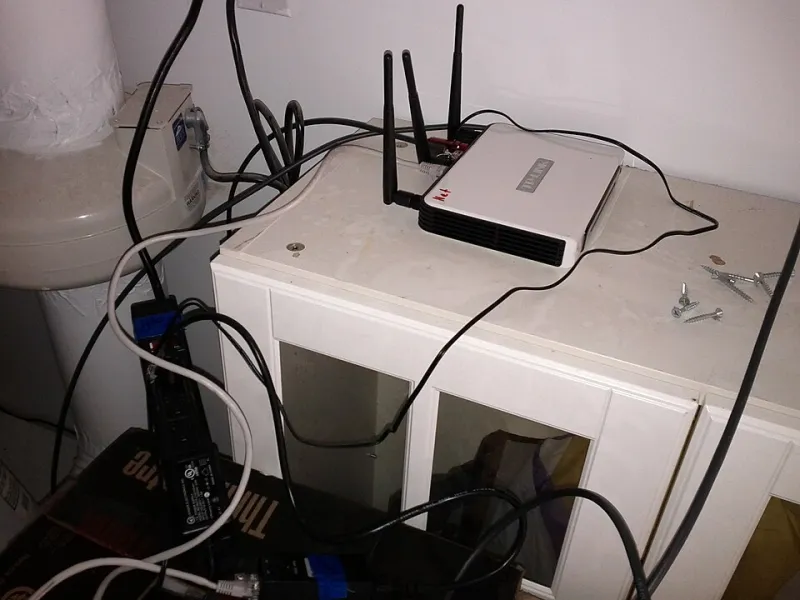
Photo: Alyx Baldwin, CC BY-SA 4.0, via Wikimedia Commons
Here's a pitch that sounds like it was designed to go viral: plug in a device, share some of your unused internet bandwidth with neighbors, earn cryptocurrency. No technical expertise required. Your router becomes a passive income machine while simultaneously helping build a community-owned alternative to Comcast.
It's a compelling story. But how much of it holds up when you look closely at the actual numbers, the actual technology, and the actual experience of people running these nodes day to day?
We spent some time with the economics, talked to people running community mesh setups across the country, and tried to separate what's real from what's marketing.
The Basic Architecture
Mesh networking itself isn't new or complicated. Instead of all devices connecting to a single central router, mesh networks let devices connect to each other, routing traffic through whichever path is most efficient. Your phone might connect to your neighbor's node, which passes traffic to another node two blocks away, which eventually hits a connection to the broader internet. The network is resilient because it has no single point of failure — knock out one node and traffic routes around it.
What's newer is the incentive layer. Traditional community mesh projects like NYC Mesh — which has been quietly building free community internet in New York for years — rely on volunteers and donations. That works, but it doesn't scale easily. Crypto-incentivized networks try to solve the scaling problem by paying people to participate.
The mechanics vary by platform, but the general shape is similar: you run a node, the network tracks how much bandwidth you're contributing, and you earn tokens proportional to your contribution. Those tokens can theoretically be sold, used for services within the network, or held as an investment.
The Platforms Doing This Right Now
Helium is the most prominent example, though its story is instructive in complicated ways. Originally focused on IoT device connectivity (its LoRaWAN network), Helium expanded into mobile data with Helium Mobile, which lets node operators earn MOBILE tokens for providing 5G coverage using compatible hardware. The pitch was straightforward: buy a hotspot device, earn tokens, help build a decentralized wireless network.
The reality has been messier. Helium's token economics went through serious turbulence as the network scaled and token prices dropped significantly from their peaks. Many early adopters who bought hardware expecting to recoup costs through token earnings found the math didn't work out. The company has restructured, migrated to the Solana blockchain, and is still operating — but it's a cautionary tale about the gap between projected and actual returns in these systems.
Althea takes a different approach that some mesh networking veterans find more sustainable. Rather than a speculative token, Althea uses a payment channel system where nodes pay each other tiny amounts for each packet of data routed through them. It's closer to a micropayment toll road than a mining operation. Althea has real deployments in rural areas of Oregon, California, and a handful of other states where it's providing actual internet access to communities underserved by traditional ISPs.
Wicrypt operates primarily in markets outside the US but is worth noting because it demonstrates the model working in places where incumbent ISP infrastructure is genuinely weak — which is where decentralized connectivity tends to perform best.
Where It Actually Works
Talk to people involved in community mesh projects and a clear pattern emerges: decentralized networking performs best in specific conditions.
Rural and underserved areas are the sweet spot. In places where your only alternative is satellite internet or a DSL connection that tops out at 10 Mbps, a community mesh network that pools bandwidth from several households and distributes it locally can be genuinely competitive. The bar isn't "beat Comcast's gigabit fiber" — it's "be better than nothing or near-nothing," which is a much more achievable standard.
Dense urban neighborhoods with engaged communities are another good fit. NYC Mesh has proven this over nearly a decade. When enough nodes are close enough together, the network becomes self-reinforcing — more nodes means better coverage and redundancy, which attracts more participants.
The model struggles in suburban sprawl, where houses are far enough apart that mesh connections require more powerful (and more expensive) hardware, and where most residents already have adequate broadband from incumbent providers. The economic incentive to participate just isn't strong enough when Comcast is already doing a passable job.
The Legal and Regulatory Tangle
This is where things get complicated for American residents specifically.
Most residential internet service agreements explicitly prohibit reselling or sharing your connection with people outside your household. If you're operating a node that's routing traffic for neighbors and earning money for it, you're almost certainly violating your ISP's terms of service. In practice, ISPs rarely go after individual mesh node operators — the traffic volumes are too small to notice — but it's a real legal exposure that participants should understand.
Spectrum use is another issue. Running a mesh network on unlicensed spectrum (like the 2.4 GHz and 5 GHz bands most WiFi uses) is generally fine for non-commercial use. Once you're earning tokens for bandwidth sharing, the regulatory picture gets murkier. The FCC hasn't weighed in clearly on crypto-incentivized mesh networking, which means participants are operating in a gray area.
Local zoning can also complicate things if you want to mount external antennas to improve range — permits, HOA rules, and building codes all potentially apply.
What the Token Economics Actually Look Like
Let's be direct about this: for most American suburban or urban residents, the token earnings from running a mesh node are unlikely to meaningfully offset your costs, let alone generate real income.
Hardware runs anywhere from $100 to $500+ depending on the network and the coverage you're trying to achieve. Electricity costs are real but modest. Token earnings depend entirely on network activity near you — if nobody's using your node, you're earning nothing. In markets where the network is sparse, that's the common experience.
The people who've done reasonably well are early adopters in areas where the network grew quickly, people who deployed multiple nodes strategically, and — frankly — people who got in early when token prices were higher and sold before they dropped.
That's not nothing, but it's a far cry from the "passive income" framing that dominates the marketing for these platforms.
Is There a Sustainable Model Here?
Despite the skepticism warranted by the hype cycle, there are real reasons to think crypto-incentivized mesh networking is pointing at something important.
The Althea model — actual micropayments for actual bandwidth, rather than speculative token mining — seems more durable than the Helium-style approach. When the economics are tied to real utility rather than token price speculation, the system has a better chance of sustaining itself through market cycles.
And the underlying problem these networks are trying to solve — the concentration of internet infrastructure in the hands of a small number of large providers who face limited competitive pressure — is real and significant. The US consistently ranks below peer nations on broadband access and affordability. Community-owned, distributed infrastructure is one of the few structural alternatives on the table.
The gap between that vision and the current reality is still wide. But it's narrowing, slowly, in the places where conditions are right and communities are committed to making it work.